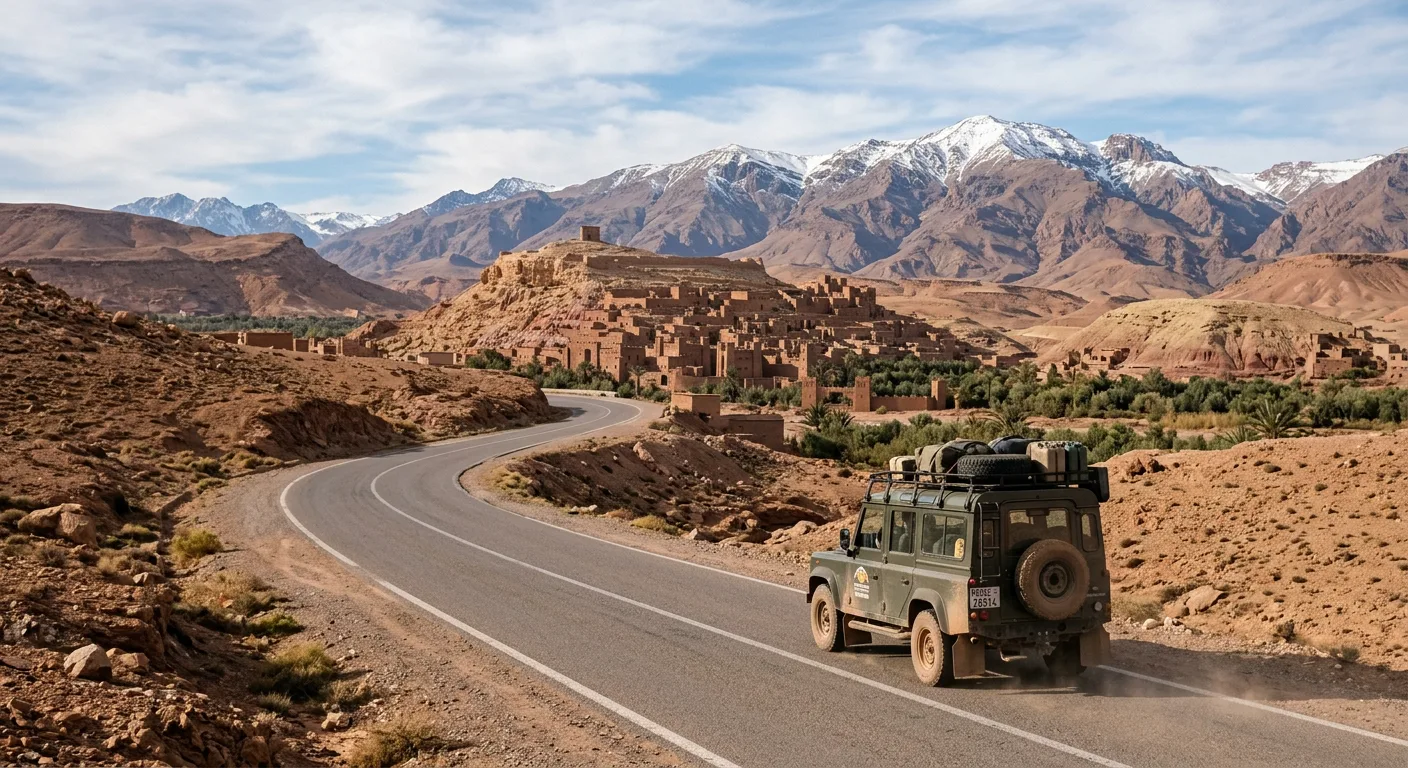
The south around Ouarzazate is a genuinely rewarding region to traverse by road — the scenery is extraordinary, the main routes are paved, and the freedom to stop at a kasbah or a gorge overlook on a whim is real. It is also a place where a few quirks demand your attention. Here is what we tell guests who ask us, honestly, whether they should rent a car.
What are the roads actually like?
Ouarzazate sits at a crossroads of three great drives. The Tizi n'Tichka climbs over the High Atlas to Marrakech — recently widened, but still hundreds of switchbacks. The N10 east runs through Skoura to the spectacular Dadès and Todra gorges, all serpentine bends and red rock. And the N9 south follows the Draa Valley to Zagora and the desert. All are paved. The genuine off-road pistes — out to Fint Oasis or the dunes of Erg Chigaga — need a 4×4 and a local driver, never a standard rental.
How do checkpoints work?
Gendarmerie checkpoints are a normal feature of southern Moroccan roads, especially on the approaches to Ouarzazate and on the desert routes. Slow down, have your passport, your licence (and IDP if you have one) and your rental contract to hand. Officers will usually glance at your documents, exchange a friendly word once they see you are a tourist, and wave you on. Morocco enforces drink-driving laws strictly — do not drink and drive. Be courteous, patient and unhurried, and the checks are quick.
What about parking at the sites and in town?
Ouarzazate town is low and spread out, so parking is rarely a problem — there is room near the Taourirt kasbah and the film studios. At Aït Ben Haddou you park on the new-town side and walk across the river to the ksar. The gorges and oases have informal parking near the trailheads, often with a guardian who expects a few dirhams. For the deep desert, you leave your vehicle at the edge of the dunes and transfer into a 4×4, as cars cannot drive into the sand.
What does car hire actually cost in Morocco?
A small manual hatchback runs approximately US$30–55 per day from international agencies (Avis, Hertz, Europcar) in Marrakech or at Ouarzazate's small airport. Local agencies advertise lower rates but their insurance and breakdown cover can be inadequate — read the small print carefully. Full collision damage waiver (CDW) and theft protection are worth paying for. Fuel is moderately priced and stations are plentiful in the towns, though they thin out on the desert and gorge roads, so fill up when you can.
Why do most of our guests choose a private driver?
We are not unbiased — we arrange private drivers for a living. But the reasons our guests give us are consistent: the Tizi n'Tichka switchbacks frayed their nerves, the desert legs felt long, they wanted to actually look at the Dadès scenery rather than navigate it, and the checkpoints felt easier with a local at the wheel. A private driver removes every one of those frictions. Over a multi-day southern loop the cost difference is modest — a driver-guide costs roughly US$120–180 per day all-in, which across a group of four works out to well under US$50 per person per day. You gain a local expert, a fixer, a translator, and someone who knows exactly where to stop above the Dadès. See our guide service for details.
Practical rules if you do self-drive
- Never drive after dark outside towns — livestock, carts and the mountain switchbacks are serious hazards.
- Download offline maps before you set off — signal can drop on the Tizi n'Tichka, in the gorges and along the Draa Valley.
- Keep a physical copy of your rental contract, insurance and passport photo page in the car.
- Fill the tank whenever you drop below half — stations are sparse on the gorge roads and the desert routes south.
- Stick to paved roads; never take a rental onto the desert pistes or into the dunes.
- At a checkpoint: slow down, window down, documents ready, friendly and patient.
Frequently asked
Is it safe to drive around Ouarzazate and southern Morocco as a foreigner?
The roads around Ouarzazate are among the easier ones in Morocco to self-drive: the main routes are paved, traffic is light outside the towns, and signs are in Arabic and French (often with Latin script). The challenges are the relentless switchbacks of the Tizi n'Tichka and the Dadès, sudden flocks of sheep on rural roads, and gendarmerie speed checks. Most visitors who drive without incident take it steadily and avoid driving after dark.
What documents do I need to rent a car in Morocco?
A valid driving licence from your home country is accepted for most nationalities; an International Driving Permit is recommended as a backup. Your passport, a credit card in your name and a minimum age of 21–25 (depending on the vehicle and company) complete the list. Keep the rental contract and the green insurance card in the car at all times.
Do the gendarmes stop tourists frequently in southern Morocco?
There are frequent gendarmerie checkpoints, especially on the approaches to Ouarzazate and on the desert roads south. Slow down, be ready to show your passport and rental papers, and you will usually be waved through with a friendly word once they see you are a tourist. Watch your speed near towns — radar checks are common and fines for speeding are issued on the spot.
What is the speed limit in Morocco?
Built-up areas: 40–60 km/h. Open roads: 100 km/h. Motorways (the toll autoroute, which does not reach Ouarzazate): up to 120 km/h. Radar and mobile speed traps are widespread, particularly on the entry roads to towns where the limit drops sharply, so ease off as you approach any village. Road signs follow international conventions.
Is it better to hire a driver than self-drive around Ouarzazate?
For most first-time visitors: yes. A private driver removes the friction points — the endless switchbacks of the Tizi n'Tichka and the Dadès, finding the unmarked turn-offs to the kasbahs, and the long desert legs toward Zagora or Merzouga — and adds local knowledge no app can replicate. Over a few days the cost difference is modest relative to the overall trip, especially split across a group.
Can I drive between sites at night in southern Morocco?
We advise against it outside towns. Unlit livestock, unmarked carts, occasional unlit vehicles and the mountain switchbacks combine to make night driving the biggest risk for visitors. Plan to reach your kasbah before dusk, particularly on the Tizi n'Tichka, the Dadès and Todra roads, and the desert routes south.
Skip the road stress
Let us put a driver-guide behind the wheel.
Our private drivers are licensed, English-speaking, and intimately familiar with every route in this guide. We can pair a driver with a separate local guide at each destination for even deeper immersion.