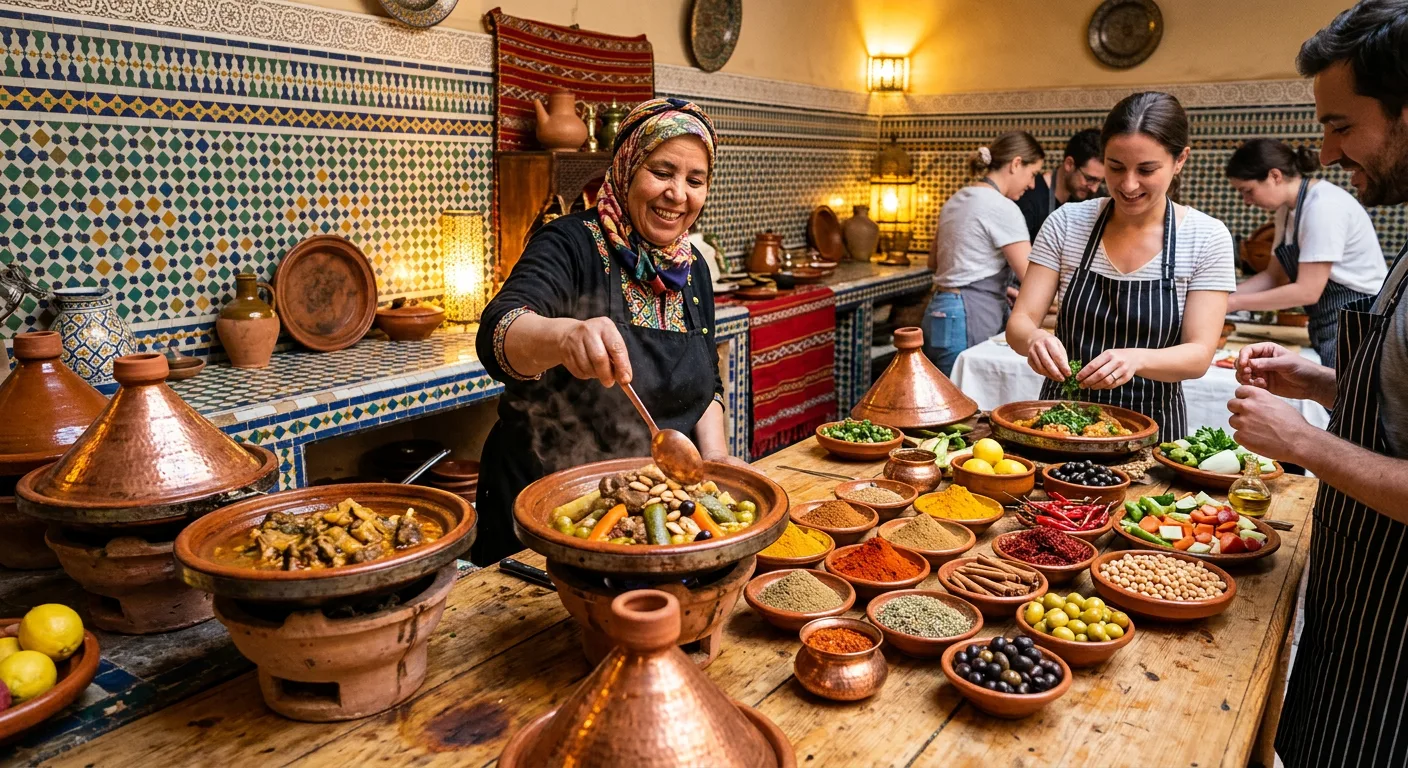
Moroccan cuisine is one of the world's great food cultures, and the pre-Saharan south has its own register: slow-cooked tagines scented with Drâa Valley dates, Berber bread baked in the sand, couscous Fridays in the kasbah villages, and the endless ritual of sweet mint tea poured in the shade of a palmery.
Dishes to seek out
Beyond the famous tagine and couscous, a few specialities reward the curious eater.
- Tagine — slow-cooked stews (lamb with prunes, chicken with preserved lemon and olives, kefta with egg).
- Couscous — traditionally the Friday family meal, steamed with seven vegetables.
- Pastilla — a sweet-savoury pie of pigeon or chicken under crisp warqa pastry and icing sugar.
- Harira — the hearty tomato-lentil soup that breaks the fast in Ramadan.
- Southern specialities — medfouna (the stuffed 'Berber pizza' of the Tafilalt and Rissani), khlea (preserved dried beef), Drâa dates, and bread baked under hot sand at a desert camp.
The tea ritual
Mint tea — green tea, fresh mint and plenty of sugar, poured from height — is the thread running through Moroccan hospitality. It's offered everywhere, from souk stalls to Berber homes, and accepting it graciously is part of the experience.
Eating well and safely
Morocco is largely Muslim, so pork is rare and alcohol is served mainly in hotels, licensed restaurants and tourist riads rather than everywhere. Tap water is best avoided for drinking — choose bottled. Busy stalls with high turnover are usually the safest (and tastiest) street food. Vegetarians do well: salads, vegetable tagines and couscous are everywhere.
Frequently asked
What is the national dish of Morocco?
Couscous and tagine are the two contenders. Couscous is the traditional Friday family meal; tagine — the slow-cooked stew named after its conical earthenware pot — is eaten across the country in countless variations.
Can you drink alcohol in Morocco?
Yes, but discreetly. Alcohol is served in hotels, licensed restaurants, tourist riads and some bars rather than universally. Outside these, especially in conservative areas and during Ramadan, it's not the norm.
Is Moroccan food good for vegetarians?
Very. Vegetable tagines, couscous, lentil soups, salads, bread and an abundance of fruit make Morocco one of the easier countries to travel as a vegetarian.
Planning a trip?
Let a Marrakech atelier handle the details.
Tell us your dates and style and we'll send a written itinerary and a transparent quote within 24 hours.
Request an itineraryKeep reading
Culture
Morocco Etiquette & Customs
A little cultural awareness goes a long way in Morocco, and even further in the conservative Berber villages of the south. Dress modestly, greet warmly, ask before photographing people, use your right hand, and embrace the unhurried Amazigh pace of mint tea and conversation that governs life along the kasbah road.
Practical
What to Pack for Morocco
Pack light, modest and layered. A southern trip swings from a hot Ouarzazate afternoon to a cold night on the Erg Chebbi dunes and a chilly dawn over the Tizi n'Tichka in a single day, so breathable layers, broken-in walking shoes and one genuinely warm top cover almost everything.
Planning
The Best Time to Visit Morocco
Spring (March–May) and autumn (September–November) are the best all-round windows for Morocco, and especially for the southern desert circuit around Ouarzazate — warm days over the kasbah road, cool nights in the Drâa and Dadès valleys, and dune light at its richest before the summer furnace arrives.