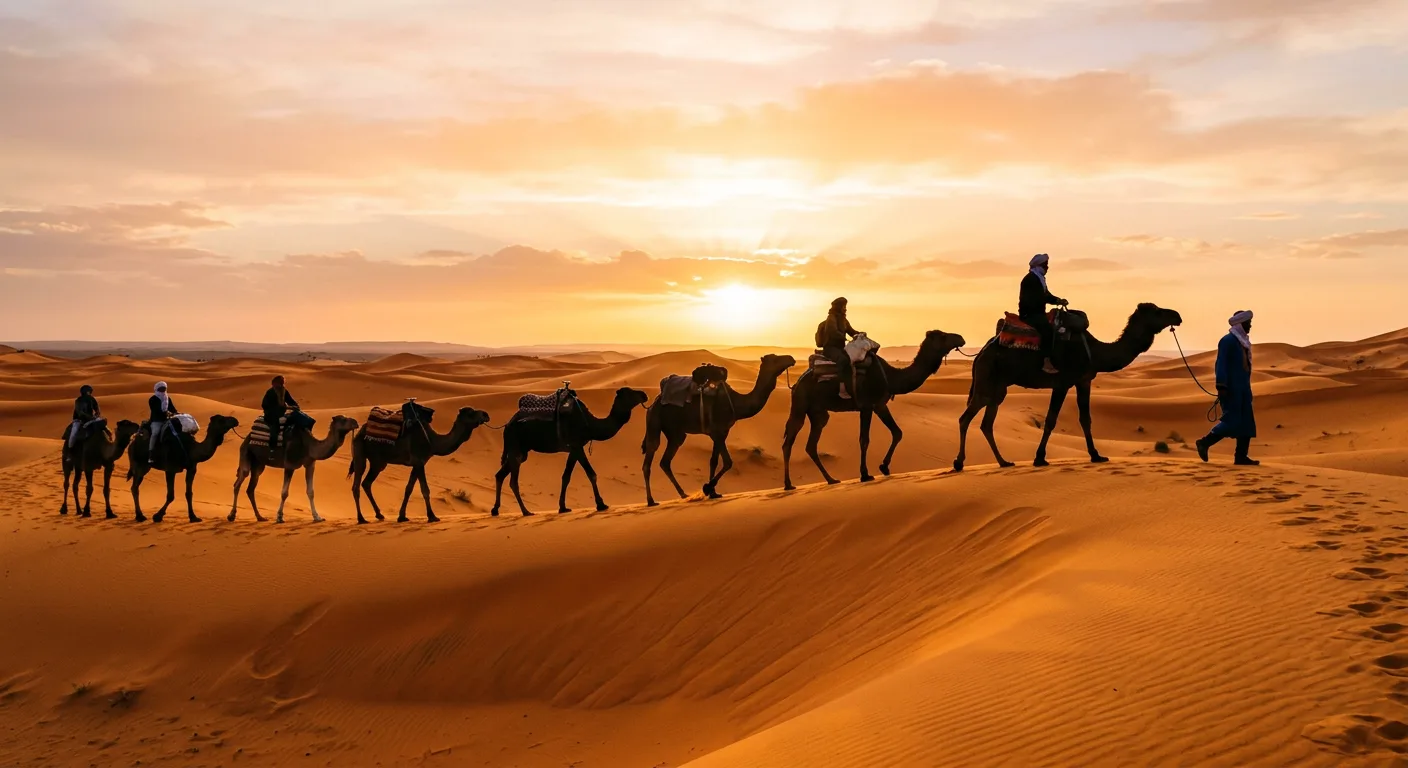
Nothing in Morocco quite prepares you for a night in the Sahara. The silence is absolute. The sky, once your eyes adjust, holds more stars than most people have seen in a lifetime. The cold — because it will be cold, even in spring — makes the morning tea inside the tent feel like the finest luxury. Here is exactly what to expect.
How camps are set up
A Sahara camp is usually a cluster of dark goat-hair Berber tents, or freestanding transparent domes, tucked between the dunes out of sight of the road, with the great waves of sand rising directly behind. At the best camps each tent or dome is a proper room: a real bed and mattress, cotton bedding, lighting, and a private bathroom with a flushing toilet and a hot shower. The dome camps add a transparent ceiling so you can fall asleep watching the stars.
Traditional Berber camps have solid beds but share clean bathroom blocks between several tents. The price difference between tiers is significant — plan to spend US$150–400+ per person at a luxury dome camp, US$50–120 at a traditional Berber camp — and the comfort difference is equally significant, though the landscape outside the door is the same.
Getting there: 4×4 or camel?
You leave your vehicle at the edge of the dunes — at Merzouga for Erg Chebbi, or M'hamid for Erg Chigaga — and transfer into a Berber 4×4 pickup, which carries you across the sand to your camp — usually 20 to 40 minutes, depending on how deep the camp sits. Most camps combine the transfer with a sunset tour of the main dunes, so you arrive as the sand turns crimson.
Camel arrival is available for the final stretch as a slower, romantic option, led by a Berber guide. The 4×4 is faster and easier, especially with young children or anyone with back concerns, and is the practical choice for an early-morning departure. Our Sahara tours include both options.
Temperature and what to pack
The desert temperature swing is remarkable. In the Sahara in October you might wear shorts at 2 pm and a down jacket by 8 pm. Between December and February, night temperatures regularly fall to 0–8 °C and can dip below freezing — cold enough that a warm layer is essential even inside a heated dome. Better camps provide thick duvets and heaters; ask in advance.
- Warm layers: fleece, down jacket, hat and gloves for December–February.
- Headtorch — even lit camps have dark paths between tents.
- Sunscreen and sunglasses for the next morning in the desert.
- Sandals for inside the tent; your shoes will fill with sand.
- Dirhams (MAD) in cash for tips — the camp manager usually distributes them collectively.
Dinner under the stars: the tagine
At a good camp, the centrepiece is a charcoal-cooked tagine — meat and vegetables slow-simmered for hours over coals, then carried out to the table at dusk; near Merzouga you may be offered medfouna, the stuffed Berber “desert pizza”. It comes with couscous, fresh bread and salads, finished with sweet mint tea. The food is genuinely good, and vegetarian and dietary requirements are accommodated easily with notice.
After dinner, Berber hosts often play the guembri and drums around the fire, and pour mint tea. The combination of fire, music, cold air and an enormous open sky is not something you reproduce at home.
Dawn in the desert
An early wake-up is not a punishment — it is the point. The light at dawn in the Sahara moves from deep purple to rose-gold across the dunes in around twenty minutes. Climbing a nearby dune before sunrise, with a thermos of tea your hosts have somehow produced, is the image many guests take home as their defining memory of Morocco.
Walking the crest of a high dune, a short camel ride or a longer 4×4 loop to a nomad family and the old desert wells are all easy morning add-ons. Read more about the Sahara and the surrounding desert.
How to choose the right camp
The Sahara camp market is broad and marketing photographs can be unreliable. A "luxury" label can mean anything from a genuine ensuite dome to a basic mattress behind a canvas partition. The safest approach is to book through an operator who physically inspects the camps they use — or to ask directly: is the bathroom private or shared? Is there a real bed? Is there hot water and heating? A good operator will answer all three without hesitation.
Frequently asked
What is it actually like sleeping in a Sahara desert camp?
At a well-run camp you sleep in a proper bed inside a goat-hair Berber tent or a transparent dome, with electric lighting and — in the better camps — a private bathroom and a heater for winter. The silence is near-total, broken only by wind over the dunes. Dawn is extraordinary: you wake to cold air, a deep blue sky and golden sand with almost no one else in sight.
How cold does it get in the Sahara at night?
Surprisingly cold. Between December and February, night temperatures regularly drop to 0–8 °C and can dip below freezing; even in spring and autumn the nights are chilly. Better camps provide thick blankets and heaters. Pack a warm layer regardless of when you travel — desert temperatures swing dramatically between day and night.
Are there proper bathrooms in Erg Chebbi camps?
At luxury dome and tent camps, yes — private flushing toilets, hot showers and proper basins. At traditional Berber camps, clean shared bathroom blocks with running water are standard. Very basic camps may have simpler facilities. Always clarify what 'private bathroom' means with your operator before booking.
How do you get to a camp inside the dunes?
You leave your own vehicle at the edge of the erg — near Merzouga for Erg Chebbi, or M'hamid for Erg Chigaga — and transfer into a Berber 4×4 pickup, which carries you 20–40 minutes across the sand to your camp. Camel arrival is available for the final stretch as a slower, atmospheric option. Ordinary cars cannot cross the deep sand, so the 4×4 or camel transfer is part of the experience.
What food is served at a Sahara desert camp?
The signature meal is a charcoal-cooked tagine — meat and vegetables slow-simmered over coals, lifted to the table at dusk — served with bread, salads and couscous; near Merzouga you may be offered medfouna, the stuffed Berber 'desert pizza'. Breakfast is eggs, olives, bread, msemen and coffee as the sun rises over the dunes. The quality is genuinely impressive given the setting, and dietary needs are easily accommodated with notice.
Is a one-night stay in the Sahara enough?
One night captures the essential experience: a sunset 4×4 tour, a tagine dinner, a sky thick with stars and a desert dawn. Two nights add a full day in the desert — time for longer walks, a camel trek over the dunes, visits to nomad families, or simply stillness. We rarely recommend fewer than one night, and two is ideal if your schedule allows.
Sleep under the stars
We only use camps we have personally visited and vetted.
Every Ouarzazate and Ait Ben Haddou Tours desert overnight includes a Berber 4×4 transfer, a sunset tour, a full tagine dinner, a sunrise excursion and a vetted tent or dome — no surprises at check-in.
Request an itinerary