South of Ouarzazate, the Drâa Valley follows Morocco's longest river through the country's longest palm grove, a green ribbon strung with mud-brick kasbahs and walled ksour on the old caravan road to Zagora and M'Hamid. It is the classic overland route from the Atlas to the edge of the Sahara. Here are the experiences worth slowing down for.
Running roughly 200 km from Agdz toward M'Hamid, the Drâa shelters one of the largest continuous palm groves in Morocco, with millions of date palms lining the river. The road threads between the palmeraie and bare ochre hills, making the drive itself one of the south's great experiences.
02Scenic drive
Cross the Tizi n'Tinififft pass
Leaving Ouarzazate, the road south climbs over the Tizi n'Tinififft, a pass through the Jebel Sarhro foothills. The descent suddenly reveals the green Drâa unfurling below, a memorable first view of the valley framed by dark volcanic rock.
03Town
Stop at Agdz
The first main town in the valley, Agdz sits beneath the flat-topped Jebel Kissane and serves as a relaxed gateway to the Drâa. Its palm grove, riverside kasbahs and small market make it a natural place to pause on the way south.
04Kasbah
Visit Tamnougalt Kasbah
Just south of Agdz, the ksar of Tamnougalt is one of the oldest and most atmospheric in the valley, once the seat of a regional caïd. Its labyrinth of earthen lanes, the old Jewish quarter and a restored kasbah open to visitors make it a highlight of the Drâa.
05Kasbah
Explore the kasbahs and ksour
The Drâa is dotted with fortified villages of packed earth, from Timidarte and Tinzouline to many smaller ksour rising straight from the palmeraie. Wandering their shaded lanes gives a sense of the caravan trade that once moved gold, salt and dates along this route.
06Food
Taste Drâa Valley dates
The valley is famous for its dates, harvested from the palms each autumn in dozens of varieties. Roadside stalls and village markets sell them fresh and dried, and growers are usually glad to explain the differences between the prized local types.
07Town
Reach Zagora and the desert sign
Zagora is the valley's main town and a long-standing departure point for desert trips. It is associated with the old caravan sign reading 'Timbuktu 52 days', a reminder that this was a real staging post on the trans-Saharan trade routes.
08Desert
Continue to M'Hamid and Erg Chigaga
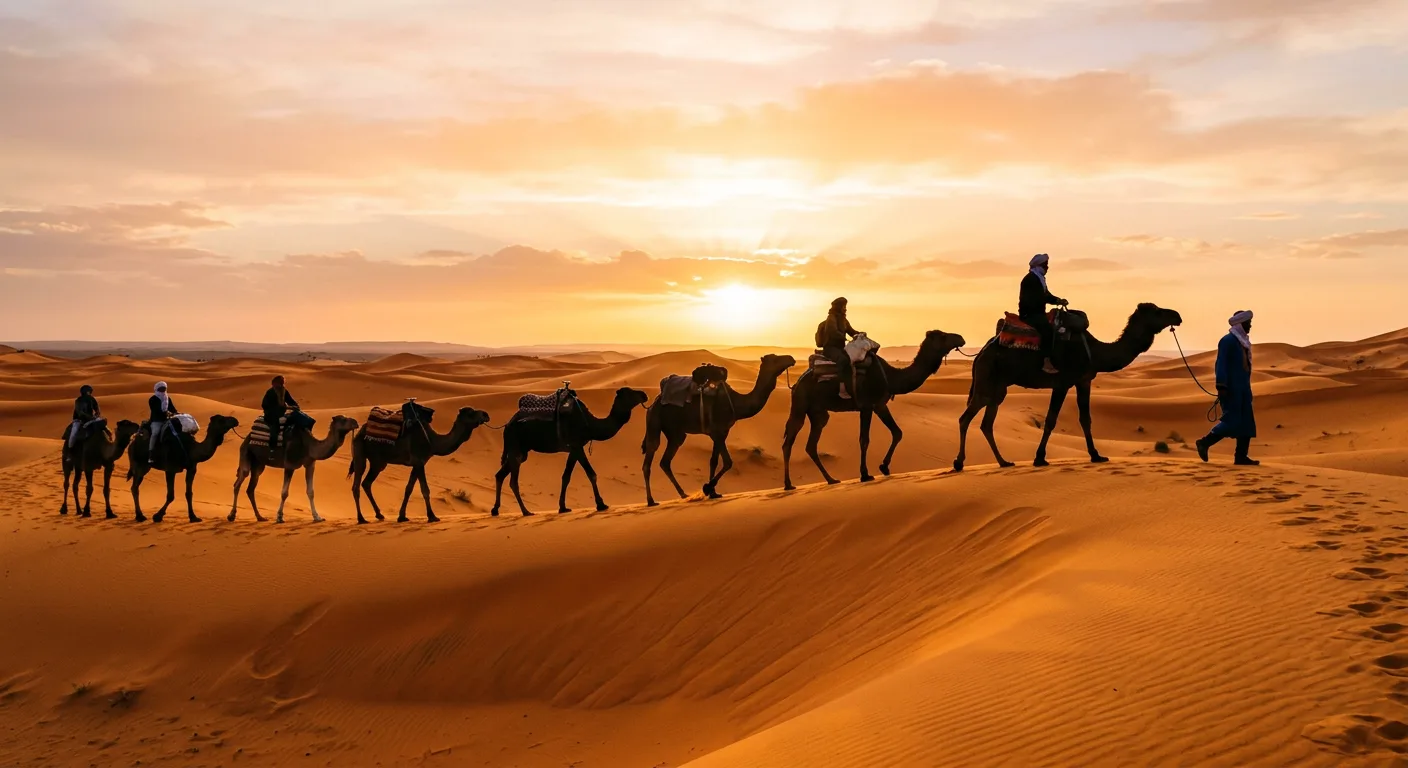
Beyond Zagora the tarmac ends near M'Hamid el Ghizlane, the last village before the open desert. From here 4x4 and camel trips set out for Erg Chigaga, a remote field of high dunes that is far quieter than the better-known ergs to the east.
09Culture
See Berber and nomad village life
The Drâa's villages are home to Amazigh and Drâawa communities who farm the palmeraie with traditional irrigation channels. Guided walks and tea with local families offer an unhurried glimpse of daily life along the river.
10Nature
Watch sunset over the palm grove
As the light softens, the palms turn deep green against ochre cliffs and the kasbahs glow warm before falling into shadow. A terrace or a quiet bend in the river makes a fine spot to take in the valley at its most photogenic hour.
Frequently asked
Where is the Drâa Valley?
The Drâa Valley begins just south of Ouarzazate and follows the Drâa River through Agdz and Zagora toward M'Hamid, on the road that leads to the edge of the Sahara. It is the main overland route between the High Atlas and the deep desert.
How long does it take to drive the Drâa Valley?
Ouarzazate to Zagora is roughly a half-day drive with stops, and continuing to M'Hamid adds another hour or two. Many travellers take it slowly over a day or more to enjoy the kasbahs, palmeraie and villages along the way.
Is the Drâa Valley a good route to the desert?
Yes. The Drâa is the classic approach to the dunes of Erg Chigaga via Zagora and M'Hamid, combining the country's longest palm grove and historic ksour with a genuine gateway to the Sahara.
What is the best time to visit the Drâa Valley?
Spring and autumn bring warm, comfortable days ideal for driving and exploring, while the date harvest in autumn is a particularly lively time. Summers are very hot and winter nights can be cold in the desert south.
See it with a local
Turn this into a private Drâa Valley trip.
We'll build a private, guided plan around the experiences you care about — with a driver, hand-picked riads and a written quote in 24 hours.