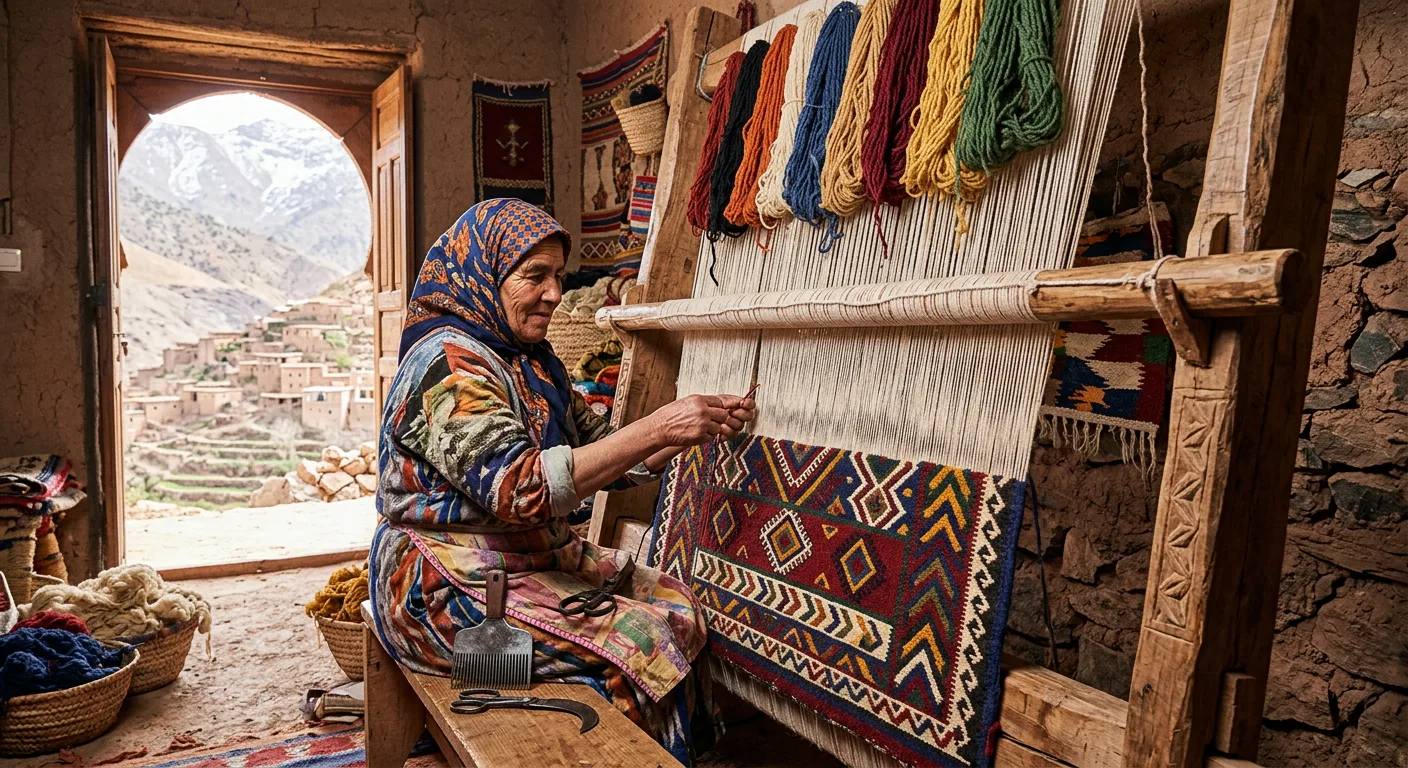
Bargaining around Ouarzazate is gentler than in the great city souks of Marrakech or Fes, but it is still part of how crafts change hands. Southern Moroccans are famously hospitable, and a sale here is often a brief, friendly exchange over a glass of mint tea that ends with a fair price and a handshake. Push too hard and you simply come across as graceless. We explain it here the way we explain it to our clients: honestly, without sentimentality, and with actual numbers.
Why the asking price is not always the real price
In the rug shops, fossil and mineral stalls and craft shops of Ouarzazate, Aït Ben Haddou and along the kasbah trail, the first price a vendor names for rugs, jewellery, fossils, pottery and "Berber" crafts often carries plenty of air — a starting point that assumes some negotiation. Buying at the very first figure simply means the vendor has done well. This is not dishonest; it is the rhythm of a souk that predates fixed pricing by centuries.
The important corollary: this only applies to a narrow set of goods. Supermarkets, pharmacies, restaurants, petrol stations and most modern shops display fixed prices. Many craft cooperatives — women's argan-oil and weaving collectives, the saffron growers and the rosewater distilleries of the Valley of the Roses — sell at fair fixed prices that support local livelihoods. When in doubt, ask whether the price is thabit (fixed) before you pick anything up.
The mechanics of a negotiation
Where bargaining does apply, a friendly southern negotiation follows a recognisable arc:
- The vendor names an opening price. At the busy sites this can be two to three times what they will ultimately accept, so do not take it as a serious starting point.
- You express interest without urgency — look at the item, ask about it, perhaps look at alternatives. Visible enthusiasm nudges the price up.
- You counter at around 40–60% of the asking price. Do not apologise for the counter-offer. State it simply and with a smile.
- The vendor comes down a little, you come up a little. The aim is to converge around 50–70% of the original ask on tourist-stall goods — a genuine discount, since the opening figure was inflated.
- When a price feels fair, accept. If it does not, you can walk away — calmly, without hostility. A vendor who has room will call you back; one who does not will let you go.
Fair price ranges to have in mind
The market changes and varies by location, but these are reasonable benchmarks around Ouarzazate and the south in 2025–2026 (MAD = Moroccan dirham):
| Item | Fair price range (MAD) |
|---|---|
| Small fossil or polished mineral trinket | 30–100 MAD |
| Argan oil, cosmetic, small bottle (cooperative) | 50–120 MAD |
| Cotton or wool scarf / shesh | 50–150 MAD |
| Saffron, genuine, per gram (Taliouine) | 30–60 MAD |
| Hand-painted ceramic plate or tagine, medium | 120–350 MAD |
| Berber silver bracelet (genuine, stamped) | 250–800 MAD |
| Leather pouf or bag, good quality | 300–900 MAD+ |
| Hand-woven Berber rug, small | 600–2,500 MAD |
These are finished prices — what you pay after a polite negotiation, not starting offers. If a vendor opens far above these figures, your counter should land near these numbers. If a vendor opens close to them, the price is already reasonable and there is little room to move.
Phrases that help
You do not need fluent Darija, but a few words used naturally signal warmth and that you have arrived prepared:
- Bshhal? — How much?
- Ghali bezzaf — Too expensive (said with a smile, not a grimace).
- Akhir taman? — Last price?
- Wakha — OK / agreed (used to close a deal).
- La, shukran — No thank you (said warmly, useful for declining a persistent pitch).
- Zwin bezzaf — This is very nice (a friendly opener).
French and often English are spoken in the south's tourist shops, and many vendors speak Tamazight (Berber) first. A salam on entering and a shukran on leaving go a remarkably long way here.
Walking away — and when to mean it
Walking away is a legitimate tool and part of the dance. A vendor who calls you back may have a little room; one who lets you go has probably offered close to a fair price. The rule is this: only walk away if you are prepared to leave. If you walk away, then turn back and pay the original price, you have given up your position and a little goodwill.
If the price is genuinely fair and you want the item, buy it. Prolonged haggling over a 50-dirham scarf wastes everyone's time and the warmth of the exchange disappears.
What to watch for in tourist areas
Most southern traders are straightforward and genuinely hospitable. A few things are worth knowing in the busiest tourist spots:
- Inflated "antique" and "silver" claims. Around Aït Ben Haddou and the studios, "Berber silver," "amber" and "ancient" fossils are often neither old nor what they claim. Buy keepsakes you simply like, not as investments.
- The unofficial site guide. Someone attaches themselves to you at the ksar, narrates, then expects a fee at the end. There is nothing wrong with hiring a local — but agree the price up front, before they start.
- Camel and mule rides. Touts press hard near the river crossing at Aït Ben Haddou. The first asking price is high; settle a clear figure before you mount, and never feel obliged.
- The "fixed-price" rug commission. Some drivers and guides steer you to shops where the price is padded to cover their cut. Buy where you choose, ideally from a cooperative, and you keep more of your money with the makers.
Buying from a recognised craft cooperative or a guide-recommended shop in the places we cover removes almost all of this friction — and keeps more of your money with the makers themselves.
Frequently asked
Is haggling expected in Ouarzazate's souks?
Yes, for crafts and souvenirs — and more so than in big-city Morocco, though gently. In the rug shops, fossil and mineral stalls and craft shops around Ouarzazate, Aït Ben Haddou and the kasbah trail, asking prices have real give and a polite negotiation is normal. But everyday shops, the supermarket, cafés and petrol stations are fixed-price, and pushing too hard on a cooperative is considered rude.
How much should I offer when haggling in Ouarzazate?
Where bargaining applies, a reasonable counter is around 40–60% of the first asking price, settling perhaps 25–40% below the original ask on tourist-stall goods. Vendors at the famous sites such as Aït Ben Haddou tend to open high, so a confident, friendly counter is appropriate. Cooperatives and argan or saffron collectives usually price fairly and fixed.
What are some useful phrases for shopping in southern Morocco?
A few phrases go a long way. In Darija (Moroccan Arabic): 'Bshhal?' (How much?), 'Ghali bezzaf' (Too expensive), 'Wakha' (OK / agreed), 'Shukran' (Thank you) and 'La, shukran' (No thank you). Many vendors in the south also speak Tamazight (Berber) and French, and 'salam' on entering matters as much as the words.
What items have fixed prices around Ouarzazate?
Supermarkets, pharmacies, petrol stations and most modern shops in Ouarzazate have fixed prices, as do entry fees and most cafés. Many craft cooperatives — women's argan-oil and weaving collectives, the saffron growers near Taliouine, rosewater distilleries in the Valley of the Roses — display fair fixed prices, and buying from them supports local livelihoods directly. When in doubt, ask whether the price is 'thabit' (fixed) before negotiating.
What should I watch out for when shopping in tourist areas?
Around Aït Ben Haddou and the studios, prices for rugs, 'Berber' jewellery, fossils and 'amber' are often inflated for visitors, and some 'silver' and 'fossil' pieces are reproductions — buy keepsakes you simply like rather than as investments. Unofficial 'guides' who attach themselves to you at the ksar and then expect a fee are common; agree any price up front before they start.
Is it rude to walk away during haggling?
Walking away is acceptable and is part of the rhythm. A vendor who lets you go has likely offered close to a fair price; one who calls you back may have a little more room. Keep it warm and unhurried. If you have no intention of buying, it is better not to start an extended negotiation in the first place — hospitality here is sincere and shouldn't be exploited.
Shop with confidence
Our guides know the southern souks intimately — and the fair prices within them.
Every Ouarzazate & Aït Ben Haddou Tours itinerary includes access to our local guides, who navigate the souks with you, make introductions to craftspeople and cooperatives they trust, and ensure you pay fair prices without anxiety.
Plan your southern visit