Yes — Ouarzazate is worth visiting, but the honest answer is that it works best as a base rather than a destination in its own right. The town itself is modern and spread out, and a single full day covers its highlights: the Taourirt Kasbah, the Atlas Film Studios and the Cinema Museum. What makes the trip is everything around it — Aït Ben Haddou about 30 km away, the Skoura palm grove, the Dadès and Todra gorges, and the Draa Valley road south toward the desert. Treat Ouarzazate as the gateway to the south and it earns its place easily.
So, is Ouarzazate actually worth it?
In favour: nowhere else in Morocco puts you so close to such a concentration of sights. Within a half-day's drive you have a UNESCO World Heritage ksar, the studios where Gladiator and Game of Thrones were filmed, two dramatic gorges, oasis palm groves and the road to the Sahara. The light here is extraordinary, the kasbah architecture is unlike anything in the imperial cities, and the pace is calm after the intensity of Marrakech.
Against: the town centre itself is functional rather than charming — built around the film industry and the regional administration, with wide modern streets rather than a tangled medina. If you come expecting a second Marrakech you will be disappointed. Come for the kasbahs, the cinema history and the surrounding country, and you will not be. For a fuller, expectations-first picture, our things to know before visiting Ouarzazate is worth a read.
How many days do you need in Ouarzazate?
One full day is enough for the town plus Aït Ben Haddou at golden hour. Give it two or three days if you want to use Ouarzazate as a base for the surrounding kasbah country — Skoura and the Valley of the Roses one day, the Dadès and Todra gorges another. Most people pass through on the way between Marrakech and the dunes and stay one or two nights. We lay out the trade-offs in our how many days in Ouarzazate guide, and a slower, opinionated plan in Ouarzazate in three days.
What is there to see in Ouarzazate town?
The Taourirt Kasbah is the obvious starting point — a labyrinthine earthen palace once held by the powerful Glaoui clan, beside the old quarter on the eastern side of town. Opposite it, the Cinema Museum displays props and sets from decades of filming. On the edge of the city, the Atlas Film Studios and the nearby CLA Studios are why locals call this place "Ouallywood".
Just outside town, the Fint Oasis is a ribbon of palms and water hidden in the bare hills, about half an hour away and a complete change of scene — see our Fint oasis guide for how to spend a quiet 48 hours there. And the calm reservoir of Lake Mansour Eddahbi sits just east of the city for anyone who wants water and birdlife in the desert.
What can you see at Aït Ben Haddou?
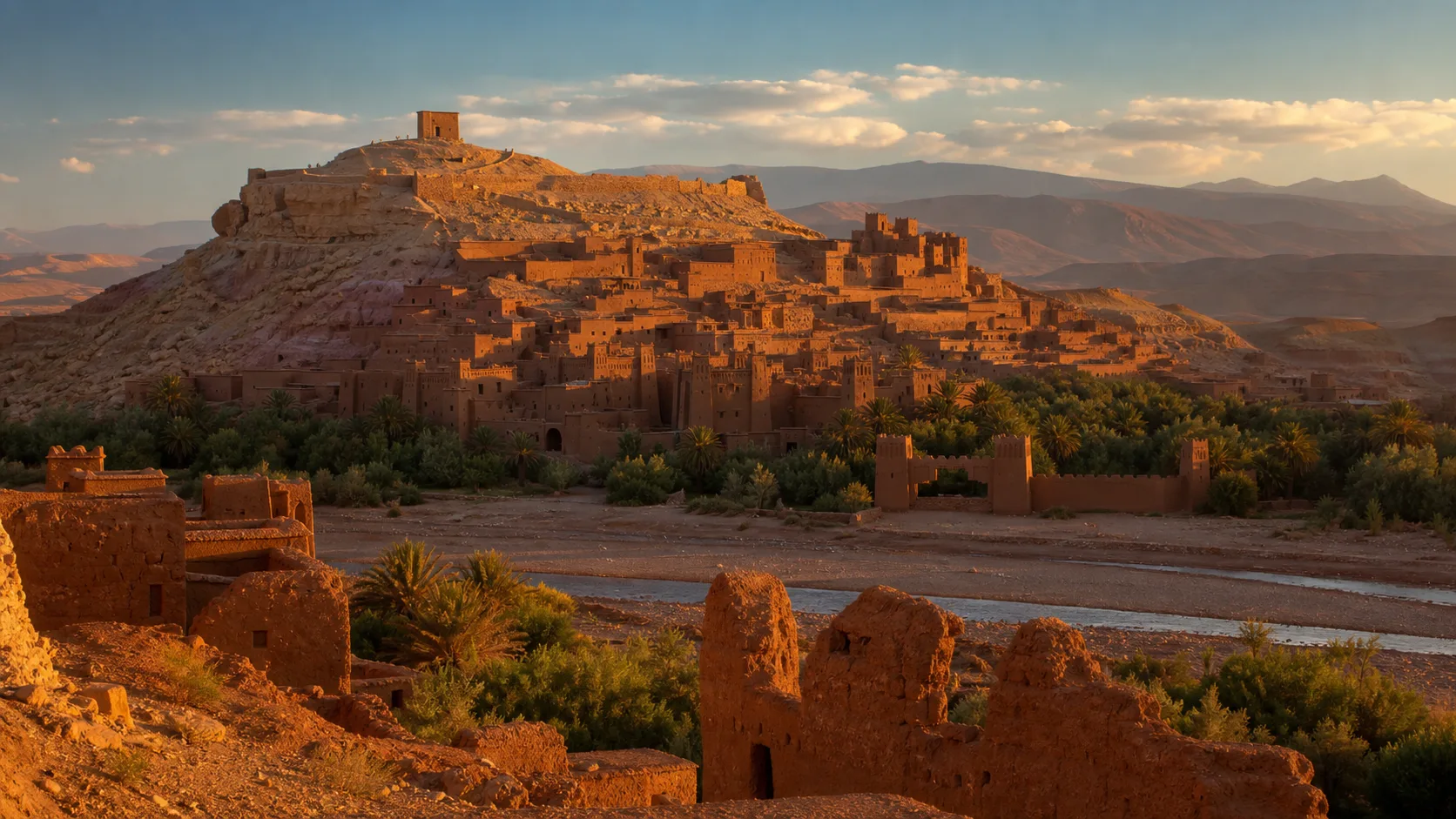
Aït Ben Haddou is the single best reason most travellers stop here. It is a fortified village — a ksar — of red-earth tower-houses climbing a hillside above the Ounila River, capped by a ruined communal granary at the summit. It has been a UNESCO World Heritage Site since 1987 and has stood in for ancient Egypt, Jerusalem and half a dozen fantasy cities on screen. It sits about 30 km northwest of Ouarzazate, an easy half-hour drive, and it glows at sunrise and sunset — which is exactly when you want to be standing in front of it.
You cross the river on the footbridge or the stepping-stones and walk straight into the village; a few of the kasbah houses charge a small fee to climb to their rooftops. Go early or stay late to dodge the mid-morning tour buses. Our full Aït Ben Haddou guide covers the climb, the films and the best timing in detail.
What are the Atlas film studios like?
Ouarzazate has been a film-making centre for half a century, and the Atlas Film Studios are the easiest way to see it. Lawrence of Arabia, Gladiator, Kingdom of Heaven, The Mummy and the desert scenes of Game of Thrones were all shot in and around the town, using the kasbahs, the open desert and purpose-built backlot sets. A studio tour walks you through standing Egyptian, Roman and Tibetan sets — theatrical, slightly weathered, and a fun counterpoint to the real kasbahs. The Atlas Film Studios guide explains what is actually on the tour and how to read the desert as a film set.
Which desert and kasbah day trips are best from Ouarzazate?
This is where Ouarzazate truly pays off. Four routes fan out from town, and you can mix them to taste:
- Skoura & the Valley of the Roses (east). The Skoura palm grove and the photogenic Kasbah Amridil are about 40 km east — a comfortable half-day — then the road climbs north into the rose-growing valley below the Dadès. See our Skoura & Valley of the Roses guide.
- The Dadès Gorge (east). The famous switchbacks sit about two and a half hours east, near Aït Oudinar, with the monkey-finger rocks just below. Long as a day trip, lovely as an overnight — our Dadès Gorge guide has the detail.
- The Todra Gorge (east). An hour beyond the Dadès, near Tinghir, the limestone walls close to a few metres apart and soar overhead, with a flat path running through the narrows. It pairs naturally with the Dadès in a loop — see the Todra Gorge guide.
- The Draa Valley (south). South of town the road crosses the Anti-Atlas at the Tizi n'Tinififft and drops into the Draa Valley — a long, palm-lined oasis of kasbahs running through Agdz toward Zagora and the desert. It is the gentler, southern route to the Sahara. Our Draa Valley things-to-do covers the stops along it.
If your real goal is the dunes, the eastern road via the gorges leads to Merzouga and the tall sands of Erg Chebbi, while the Draa runs south to Zagora and Erg Chigaga. We compare the two in Merzouga vs Zagora, and map the whole eastern route in the Road of a Thousand Kasbahs.
How do you get to Ouarzazate from Marrakech or Fes?
From Marrakech, the only road is the Tizi n'Tichka pass over the High Atlas — about 200 km and roughly four hours, longer with stops. It is a spectacular but winding crossing, recently upgraded in parts, and it makes sense to break it at the Glaoui palace of Telouet or at Aït Ben Haddou before rolling into town. Our guide to driving the Tizi n'Tichka covers the stops and the timing.
From Fes, it is a long two-day journey south via Midelt and the Ziz Valley, usually broken with a night near Merzouga or in the gorges rather than driven in one go. There is also a small airport (OZZ) with limited domestic flights. Whichever way you come, most visitors travel by private car, organised tour or the CTM/Supratours buses — and if you would rather not drive the mountain bends yourself, we can arrange a driver.
When is the best time to visit?
- Spring (mid-March–May) — warm, dry and clear, with the rose harvest near El Kelaâ M'Gouna in May. The standout window.
- Autumn (mid-September–early November) — settled weather and good light on the kasbahs, with fewer crowds than spring.
- Summer — hot and intensely sunny; start early, rest at midday and save the gorges (cooler than the open desert) for the afternoon.
- Winter — crisp, clear days and quiet roads, but genuinely cold after dark and the chance of snow on the high passes.
For the full month-by-month picture, see when is the best time to visit Ouarzazate.
Frequently asked
Is Ouarzazate worth visiting, or is it just a stopover?
It is worth visiting — but mostly as a base rather than a destination in itself. Ouarzazate town is modern and spread out, and a single full day covers its highlights: the Taourirt Kasbah, the Atlas Film Studios and the Cinema Museum. The real reward is everything around it — Aït Ben Haddou 30 km away, the Skoura palm grove, the Dadès and Todra gorges, and the Draa Valley road south toward the desert. Treat Ouarzazate as the gateway to the south and it earns its place easily.
How many days do you need in Ouarzazate?
One full day is enough for the town itself plus Aït Ben Haddou at golden hour. Give it two or three days if you want to use it as a base for the surrounding kasbah country — Skoura and the Valley of the Roses one day, the Dadès and Todra gorges another. Most travellers spend one or two nights here on the way between Marrakech and the Sahara rather than a long stay.
What is the main thing to see in Ouarzazate?
In town, the Taourirt Kasbah — a sprawling earthen palace of the Glaoui clan beside the old quarter — and the Atlas Film Studios on the edge of the city are the headline sights, with the Cinema Museum opposite the kasbah. But the single best reason to come is Aït Ben Haddou, the UNESCO-listed ksar about 30 km northwest, which is genuinely one of the most striking places in Morocco at sunrise or sunset.
Which day trips are best from Ouarzazate?
The classics are Aït Ben Haddou and the Ounila valley to the northwest; the Skoura palm grove and the Valley of the Roses to the east; the Dadès and Todra gorges further east along the Road of a Thousand Kasbahs; and the Draa Valley south toward Agdz and Zagora. Skoura and Aït Ben Haddou are comfortable half-days; the gorges and the Draa are longer full days and often better as overnights.
How do you get to Ouarzazate from Marrakech?
By road over the Tizi n'Tichka pass — about 200 km and roughly four hours, longer with stops. It is a spectacular but winding High Atlas crossing, so allow time and break it at Telouet or Aït Ben Haddou. There is also a small airport (OZZ) with limited domestic flights. Most visitors arrive by private car, organised tour or the CTM/Supratours buses from Marrakech.
When is the best time to visit Ouarzazate?
Spring (mid-March to May) and autumn (mid-September to early November) are ideal — warm, dry, clear days for the kasbahs and the gorges, and the May rose harvest near El Kelaâ M'Gouna. Summer is hot and intensely sunny, so start early and rest at midday; winter brings crisp clear days but cold desert nights and the chance of snow on the high passes.
Make the most of the gateway
We build Ouarzazate into trips that actually flow.
The town's highlights, Aït Ben Haddou at golden hour, the studios, and whichever day trips suit you — Skoura, the gorges or the Draa toward the dunes. Private car, kasbah hotels we trust, early starts. Tell us your dates and we'll shape the rest.